Choosing a bench for serious strength training takes more than checking the advertised weight limit. Stability, frame construction, pad support, adjustment range, and compatibility with your rack or barbell setup all affect how confidently you can train.
We’ve gathered 10 heavy-duty adjustable and flat benches for home gyms, including commercial-style models, foldable options, and bench-and-rack packages. Use the guide below to narrow the list based on your lifting style, available space, and equipment.
Best 10 Weight Benches for Heavy Lifting Picks for 2026
Best Overall
FLYBIRD WB7 Heavy-Duty Adjustable Bench

- 1,300-pound tested capacity and reinforced steel frame
- 34-inch backrest with IPF-standard height
- Six backrest and three seat positions
Best For: Versatile home-gym strength training and taller users
Highest Capacity
YOLEO ASTM-Certified Commercial Bench

- 2,315-pound test load capacity
- Three-post design for lateral stability
- Ten backrest and three seat positions
Best For: Serious lifters and commercial-style training environments
Best Adjustable Value
MAJOR FITNESS 36-Position Bench

- 1,300-pound capacity with triangular steel frame
- 36 positions across nine backrest and four seat settings
- 31.5-inch backrest and 2.5-inch padding
Best For: Flexible home-gym workouts and frequent angle changes
Most Versatile
Commercial 1800-LB Adjustable Bench

- 1,800-pound capacity and heavy-duty steel frame
- Leg extension and preacher-curl elbow support
- Folds upright and includes rear wheels
Best For: Full-body home workouts in space-conscious gyms
Heavy-Duty Flat Bench
Steelbody Deluxe Utility Weight Bench
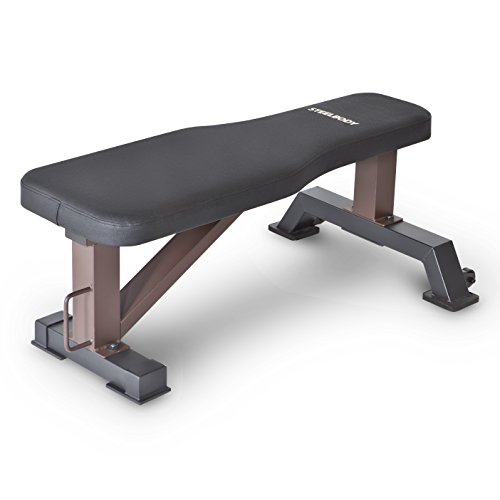
- 800-pound maximum capacity
- Stable alloy-steel frame with thick vinyl padding
- Transport wheels support convenient storage
Best For: Home dumbbell workouts and straightforward flat-bench training
Adjustable Strength Pick
RITFIT Adjustable Weight Bench

- 1,300-pound maximum capacity
- 10 backrest positions and 3 seat angles
- 2.75-inch sweat-resistant leather cushion
Best For: Versatile incline, flat, and decline home workouts
Full-Station Heavy Lifter
YOLEO Olympic Weight Bench Set

- 1,980-pound total listed system capacity
- Wide rack with safety catches and safety pin
- Bench, rack, leg, curl, and core-training functions
Best For: Space-equipped home gyms seeking an all-in-one strength station
Heavy-Duty Pick

- ASTM-certified 1,200-pound capacity
- 36 backrest and seat angle combinations
- Wheels and upright storage aid portability
Best For: Serious home strength training and heavy lifting
Space-Saving Choice

- ASTM-certified 800-pound support
- Adjusts from -30° decline to 90° upright
- Folds to approximately 9.06 inches wide
Best For: Small home gyms and apartment storage
Attachment-Focused Pick

- 1,000-pound heavy-duty capacity
- Includes preacher pad and leg developer
- Folds for more convenient storage
Best For: Full-body routines with curls and leg exercises
Best Overall – FLYBIRD WB7 Heavy-Duty Adjustable Bench
For shoppers comparing weight benches for heavy lifting, the FLYBIRD WB7 stands out with a tested 1,300-pound capacity, reinforced steel frame, and IPF-standard 17.7-inch height. Its long backrest and fast adjustments make it practical for pressing and a broad range of home-gym strength exercises.
Best For: Lifters who want a stable, versatile adjustable bench with extra head and neck support.
Pros:
- 1,300-pound tested capacity with a triangle-reinforced alloy-steel frame.
- 34-inch backrest supports the head and neck, including for users over 6 feet tall.
- Six backrest and three seat positions adjust quickly for flat, incline, and shoulder-focused work.
- Wheels and a handle simplify repositioning around a home gym.
Cons:
- At 48.5 pounds, it may be heavier to carry than compact benches.
- The listed warranty covers the frame and parts for one year.
The WB7 is a well-rounded choice when stability, long-backrest comfort, and easy movement matter as much as raw capacity. It is especially appealing for home lifters who want commercial-style construction without sacrificing adjustability.
Highest Capacity – YOLEO ASTM-Certified Commercial Bench
Among weight benches for heavy lifting, the YOLEO Commercial Weight Bench is built for users prioritizing maximum load support and competition-style stability. Its three-post structure, reinforced steel components, and 2,315-pound test load capacity suit demanding training in home or commercial settings.
Best For: Experienced lifters seeking an exceptionally high-capacity bench with extensive angle adjustment.
Pros:
- 2,315-pound test load capacity supported by an H-shaped back support and triangular frame.
- Three-post design and reinforced foot pads are intended to improve lateral stability.
- Ten backrest positions from -15 to 90 degrees and three seat settings support varied exercises.
- Includes a 32-inch backrest, 2.4-inch high-density padding, wheels, and a 10-year frame-and-components replacement service.
Cons:
- Its heavy-duty specification may be more than casual or beginner lifters need.
- The notes describe it as 80% pre-assembled, so some setup remains necessary.
YOLEO is the capacity-focused option in this group, with adjustment range that includes decline work and a full upright position. Its commercial-oriented construction makes the most sense for serious strength training where stability and long-term coverage are priorities.
Best Adjustable Value – MAJOR FITNESS 36-Position Bench
The MAJOR FITNESS bench is a practical contender among weight benches for heavy lifting, combining a 1,300-pound capacity with 36 total adjustment positions. Its triangular frame, dual-track backrest support, and compact rolling design make it suitable for demanding home-gym sessions.
Best For: Home-gym users who want broad positioning options and commercial-style construction.
Pros:
- 1,300-pound maximum capacity with a commercial-grade square-steel triangular frame.
- Nine backrest and four seat positions provide flat, incline, and decline configurations.
- 31.5-inch backrest and 2.5-inch padding support comfort during longer workouts.
- Waterproof, wear-resistant PU upholstery plus wheels and a handle aid daily use and storage.
Cons:
- The one-year component replacement warranty is shorter than some competing coverage plans.
- At 59 pounds, moving it may require more effort despite the wheels.
This bench offers a strong balance of load capacity, adjustability, comfort, and mobility. It is a sensible pick for home lifters who regularly switch between pressing angles and want a sturdy bench without a highly specialized feature set.
Most Versatile – Commercial 1800-LB Adjustable Bench
For buyers looking beyond basic weight benches for heavy lifting, this commercial adjustable model adds removable-style training supports for preacher curls and leg exercises. Its 1,800-pound capacity, dual backrest support, and foldable storage design give it a broad full-body role in a home gym.
Best For: Lifters who want one bench for pressing, curls, leg work, and space-conscious storage.
Pros:
- 1,800-pound maximum capacity with a heavy-duty steel frame and wide rear foot.
- Includes leg extension and four-position elbow support for leg exercises and preacher curls.
- Separate headrest and backrest offer multiple settings for flat, incline, and decline training.
- Folds upright and uses rear wheels for easier storage and movement.
Cons:
- Its additional attachments may take more space and setup time than a basic bench.
- The supplied notes do not specify the exact number of backrest angle positions.
This is the feature-rich choice for users who want to consolidate several upper- and lower-body movements around one bench. The folding design helps offset its broader functionality, particularly in a compact home-gym space.
Heavy-Duty Flat Bench – Steelbody Deluxe Utility Weight Bench
If you want straightforward weight benches for heavy lifting, the Steelbody Deluxe Utility Bench focuses on stability, durability, and easy storage. Its 800-pound maximum capacity, alloy-steel frame, thick vinyl padding, and transport wheels make it a practical choice for dumbbell-based home workouts.
Best For: Lifters who want a sturdy flat bench for full-body dumbbell training in a home gym.
Pros:
- Supports up to 800 pounds.
- Heavy-duty steel construction includes foot pads and end caps for stability.
- Transport wheels and a handle simplify repositioning and storage.
- 2.5-inch faux-canvas vinyl padding provides back support during training.
Cons:
- Flat design does not provide incline or decline adjustments.
- Dumbbells are not included.
- At 35 pounds, it may offer fewer features than larger adjustable systems.
This is a focused, durable flat bench rather than an all-in-one station. Choose it if dependable support and compact mobility matter more than multiple backrest angles or integrated attachments.
Adjustable Strength Pick – RITFIT Adjustable Weight Bench
Among weight benches for heavy lifting, the RITFIT Adjustable Weight Bench stands out for its high stated capacity and broad positioning range. It offers 10 backrest positions, three seat angles, a triangular base, and 2.75-inch cushioning for users who want to move between flat, incline, and decline exercises.
Best For: Home-gym users who need one adjustable bench for varied pressing and strength-training angles.
Pros:
- Tested for up to 1,300 pounds.
- Ten backrest positions and three seat angles support flat, incline, and decline work.
- 50-by-70-millimeter industrial-grade steel frame is welded for structural strength.
- Thick sweat-resistant leather cushioning and transport wheels add comfort and mobility.
Cons:
- At 57 pounds, it is heavier to move than a basic flat bench.
- Its 47.8-inch depth requires more floor space than a compact utility bench.
- Weights and other training accessories are not listed as included.
The RITFIT is a versatile middle ground for serious home training: substantially rated without the added footprint of a rack-based system. Its adjustment range is the main advantage for lifters who regularly change exercises.
Full-Station Heavy Lifter – YOLEO Olympic Weight Bench Set
For shoppers seeking weight benches for heavy lifting with rack functionality, the YOLEO Olympic Weight Bench Set combines an adjustable bench, wide press rack, and several attachments. Its listed total system capacity is 1,980 pounds, while safety catches and a safety pin are designed to support solo training.
Best For: Lifters who want a broad home-gym setup for bench pressing, squats, leg work, curls, and core exercises.
Pros:
- System capacity is listed as 1,980 pounds across the bench, squat rack, and leg frame.
- 47.44-inch-wide rack accommodates wider grips and 7-foot Olympic bars.
- Eight backpad settings cover incline, flat, and -30-degree decline positions.
- Includes protective squat-bar catches, a safety pin, multiple attachments, and 10-year frame and component coverage.
Cons:
- The 93.7-inch length and 61.54-inch height require substantial floor and ceiling clearance.
- Barbells and dumbbells are not included.
- Its 81.6-pound weight makes relocation less convenient than a standalone bench.
This is the most expansive option of the three, but it also demands the most space. It makes sense when you want one integrated station for pressing, squats, leg training, and core work rather than a bench alone.
Heavy-Duty Pick – Keppi 1200LB Adjustable Bench
For shoppers comparing weight benches for heavy lifting, the Keppi stands out with an ASTM-certified 1,200-pound capacity and a fully welded commercial-grade steel frame. Its broad adjustment range supports flat, incline, and decline training, while the 17.3-inch height helps maintain a stable lifting position.
Best For: Heavy strength training and full-body home gym workouts where maximum capacity and stability are priorities.
Pros:
- ASTM-certified 1,200-pound weight capacity
- 12 backrest and 3 seat positions provide up to 36 angle combinations
- Adjustable foot catch supports decline exercises
- Wheels, handle, and upright storage make it easier to move and store
Cons:
- Its heavy-duty construction may be more bench than casual users need
- It offers many adjustments, which may take more setup time than a simpler bench
The Keppi is a strong choice when your priority is a high-capacity, gym-style bench that can handle pressing, rows, hip thrusts, core work, and other demanding exercises without sacrificing adjustability.
Space-Saving Choice – FLYBIRD FB800 Foldable Bench
The FLYBIRD FB800 is a practical option among weight benches for heavy lifting if you need substantial support without giving up storage space. Its ASTM-certified 800-pound capacity, dual-triangle frame, and double-locking mechanism provide a stable base, while the foldable design reduces its footprint by 80 percent.
Best For: Apartment dwellers and home gym users who want an adjustable, high-capacity bench that stores compactly.
Pros:
- ASTM-certified support up to 800 pounds
- Adjusts from -30° decline to 90° upright for full-body training
- Extended backrest and spacious seat support controlled pressing movements
- Folds to about 9.06 inches wide for narrow storage
Cons:
- Its 800-pound capacity is lower than the 1,000- and 1,200-pound options in this roundup
- Foldable construction may appeal less to users who want a permanently set-up bench
With quick spring-lock adjustments, a leveling footpad, and a relatively light 28.5-pound design, the FB800 balances lifting versatility with easy storage. It is especially useful when floor space is limited but you still want incline, flat, decline, and upright positions.
Attachment-Focused Pick – XCHIEF 1000LB Foldable Bench
For weight benches for heavy lifting that also support accessory work, the XCHIEF combines a stated 1,000-pound capacity with a preacher pad and leg developer. Its adjustable backrest, preacher pad, and foot positions let you build varied full-body sessions, and the foldable frame is designed for home storage.
Best For: Home users who want one bench for pressing, curls, leg extensions, and other accessory-focused exercises.
Pros:
- Commercial-grade steel frame rated for 1,000 pounds
- Includes a preacher pad and 2-in-1 leg developer
- Waterproof PU leather and dense foam padding support comfort during training
- Folds to 36 x 12.6 x 25.2 inches for storage
Cons:
- Weights are not included
- The included attachments add versatility but may require more setup than a basic bench
- Its listed expanded dimensions require more floor space during use
The XCHIEF is the most accessory-oriented option here. Its 1,000-pound rating suits demanding workouts, while the preacher pad and leg developer make it a flexible choice for users who want more than a standard press bench in a compact home setup.
How We Picked These Weight Benches for Heavy Lifting
We focused on benches marketed for high-load strength training and compared their stated weight capacities, adjustment systems, bench positions, construction features, padding, portability, and intended use. A high capacity is useful, but it does not automatically mean a bench is the best choice. Overall stability, a secure adjustment mechanism, a level platform, and a comfortable pad matter just as much during pressing and supported exercises.
Because listed capacities can include the user and lifted weight, check each manufacturer’s definition before buying. Also confirm dimensions, shipping weight, and assembly requirements, particularly for commercial-style benches.
Quick Comparison
- Best for maximum listed capacity: Look at the 1,800-pound and 2,315-pound options, while verifying how each brand calculates capacity.
- Best for adjustability: Models with multiple incline, decline, and flat positions offer more exercise variety.
- Best for smaller spaces: Foldable benches are easier to store, but check whether their lighter design meets your stability expectations.
- Best for barbell setups: An Olympic bench set or a bench designed for rack use may simplify a complete home-gym build.
Key Buying Factors for Weight Benches for Heavy Lifting
Capacity and Frame Strength
Choose a stated capacity comfortably above your current combined body weight and lifting load. Heavy-gauge steel, reinforced joints, wide feet, and minimal frame flex are valuable indicators of a stable platform.
Adjustment Range and Pad Design
Flat position is essential for conventional bench pressing, while incline settings support shoulder and upper-chest work. Decline adjustment can add versatility, but it is less important if you mainly perform flat and incline presses. Look for a firm, supportive pad with durable upholstery and enough length to support your shoulders and head.
Stability and Compatibility
A bench should remain planted when you unrack or press heavy weight. Check its width, foot design, gap between seat and back pad, and compatibility with your power rack, squat stands, or bench-press station. A bench that is too wide or tall may not work well with existing equipment.
Storage, Assembly, and Warranty
Foldable designs help in multipurpose rooms, but hinges and locking points deserve close inspection. Review assembly instructions, return policies, replacement-part availability, and warranty coverage before committing to a large or heavy product.
Who Should Buy Which Weight Benches for Heavy Lifting?
Power-focused lifters should prioritize a rigid commercial-style bench with a generous capacity, broad base, and minimal movement. General home-gym users will usually get the best value from an adjustable bench with flat, incline, and decline positions. Apartment or shared-space users should consider a foldable model, provided its capacity and stability suit their training loads. Beginners building a complete setup may prefer an Olympic bench set that includes a rack, while experienced lifters with existing racks should choose a standalone bench that fits their equipment precisely.